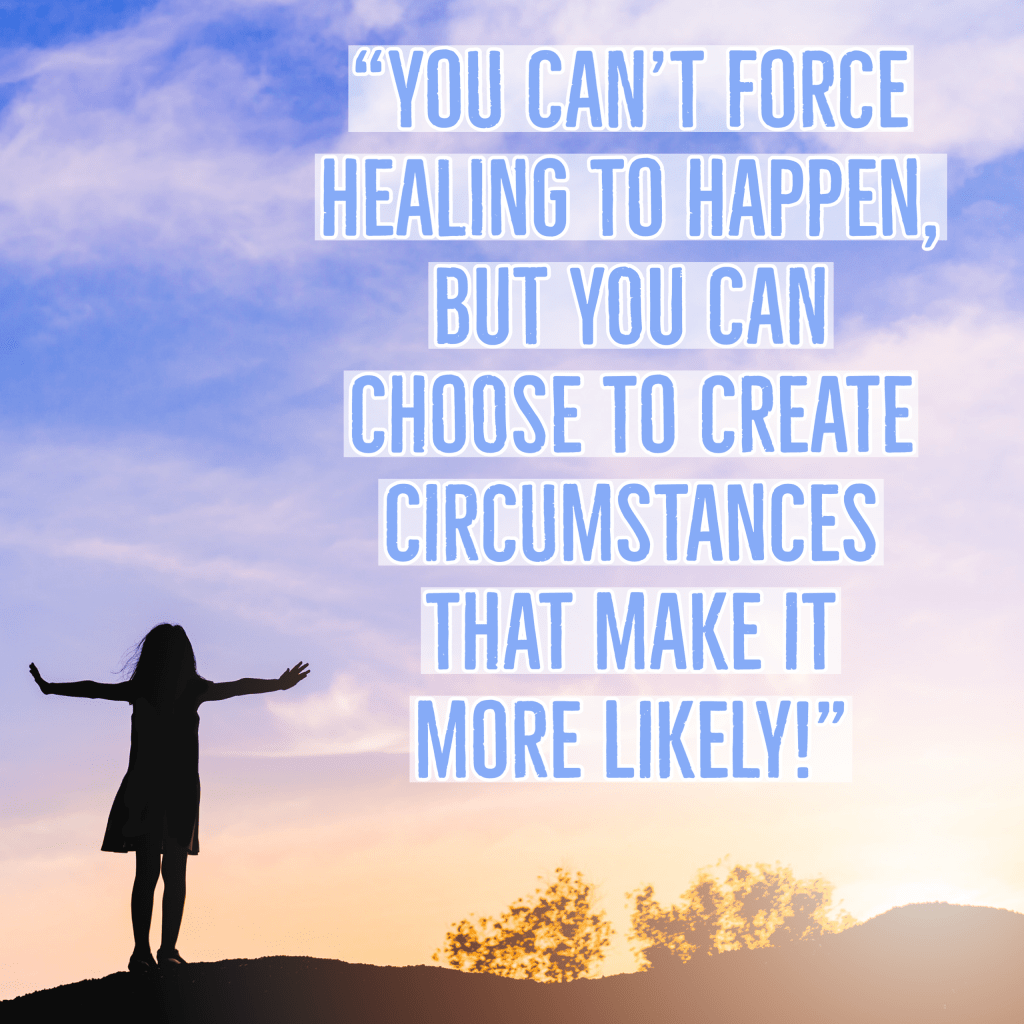
One aspect of dealing with chronic pain that has always frustrated me is how many health care providers think that they can rush you through a program or treatment route as fast as possible and have success at the end. A chronic illness is just that – chronic. You can’t rush a patient through various sessions and advance them above their capabilities faster then they can keep up. This last week I have been enrolled in an overcoming chronic pain summit. One presenter made a key point that you can’t force healing to take place. All that we can do is to create circumstances that make it more likely! Many chronic illnesses ( including fibromyalgia) can’t be healed or cured, but we can learn how to manage our symptoms to the best of our abilities. In order to do so we must first find strategies that work for us as individuals. What works for one person may not benefit another , but make their pain worse.
We can’t force heal a sprained ankle or broken bone. Both injuries take time to heal. If a person requires a cast for six weeks we can’t take that cast off after three and call it good. What makes health care providers think that chronic pain can be forced to be cured or improved!? Even for myself when I was first diagnosed with fibromyalgia I thought I would have myself back up and on the go within a month – was I ever wrong.

We are often convinced that if we take part in yoga, exercise, getting a good night sleep, eating a healthy diet and adding meditation – our chronic pain will magically disappear. It is ingrained into our mind to do as the health care providers say to get our life back to how it once was. I was convinced at the beginning that if I followed what the doctors told me, the pain would stop, and the fatigue would ease. What I found was as time went on both symptoms got worse, and new symptoms appeared. Fibromyalgia is not limited to just pain and fatigue! There are over three hundred symptoms a person with fibromyalgia may experience! I felt like a false sense of hope was engraved into my brain by being told to use these strategies and I would improve. After seeing no improvements you begin to blame yourself as a human being for seeing no changes. You begin to ask yourself what you are doing wrong. You question your sanity more and more. All of which takes a toll on you mentally and physically – causing higher pain levels to result. I personally feel health care providers need to be more clear and explain that these strategies can help create circumstances that MAY improve symptoms. I often think doctors expect patients to read as a text book – meaning here is a symptom and here is the fix. Sadly sometimes illnesses defy the scientific world and it is not always that easy to treat the said symptoms or condition at hand.

I think back to the first pain clinic I attended. I found that the pain clinic wanted to advance me between exercises too fast. Most of the stretches I could not even do or they had to be modified to a laying down version. I found at each appointment they wanted to add more and more exercises on, when I felt I hadn’t had time to allow the previous ones to benefit my body or explore them enough to even see if they would be appropriate for me. They began advancing through sessions so quickly I was beginning to have anxiety and becoming emotional because it was so rushed. I felt like the quickness of the program, set me up for automatic failure. There was such a long waiting list to be accepted into the program, that it began to feel like I was just a number and being pushed through the motions of the program so that they could discharge me and move onto the next patient. I never felt like the multidisciplinary team that was involved in my care while I was in this program even cared about my well being – just going through the motions to get me in and out of the program as fast as possible.
The same experience was noted at the second pain clinic I attended. Even though the main focus of the program was to help improve my quality of life, I was only given a max of eight sessions before being discharged from the program. I again felt I had not benefited from the program due to the fact it was such limited guidance. People with chronic conditions can’t even begin to possibly unravel and decode what they need in such a limited time frame – especially when the symptoms/condition change by the minute or hour. I was never really even given any useful strategies that could help lower pain levels.

Trying to get a grasp on chronic pain takes commitment and dedication. There is no such thing as a one size fits all when it comes to health and well being. Different strategies work for different people at different times in their lives. Often times we must step out of our comfort zones to find strategies that work.
My advice to others struggling:
1. Never give up. Even if strategies do not work at first. Slow but steady wins the race. Keep trying new strategies. Go back and try old strategies later on.
2. You can’t rush through chronic pain strategies and expect success. Slow down. Listen to your body.
3. It takes dedication and commitment. You can’t try a strategy for a week or two. It takes time to see results. Many people get discouraged when results are not immediate. For example, athletes must become dedicated to train to win the final race. They have to keep at it to see results.
4. Be open to all strategies even if they sound strange. We sometimes have to step out of our confront zone to find successful strategies. I used to roll my eyes at the thought of meditation helping lower pain levels and helping me sleep. After a month of meditating right before bed, I have noticed a decline in pain levels at night and sleep better. In the past meditation always failed – or did it? I think it was more me sabotaging the success from thinking it wouldn’t work. I am also learning the way we think and react to situations affect pain levels.
5. If you are finding health care providers are rushing through the motions to help improve chronic pain speak up ( the sooner the better). I felt I waited too long and then when I spoke up I got labelled as difficult. My doctor who diagnosed me also had to tell other providers to slow down and listen to what I have to say.

 FibroFighters